
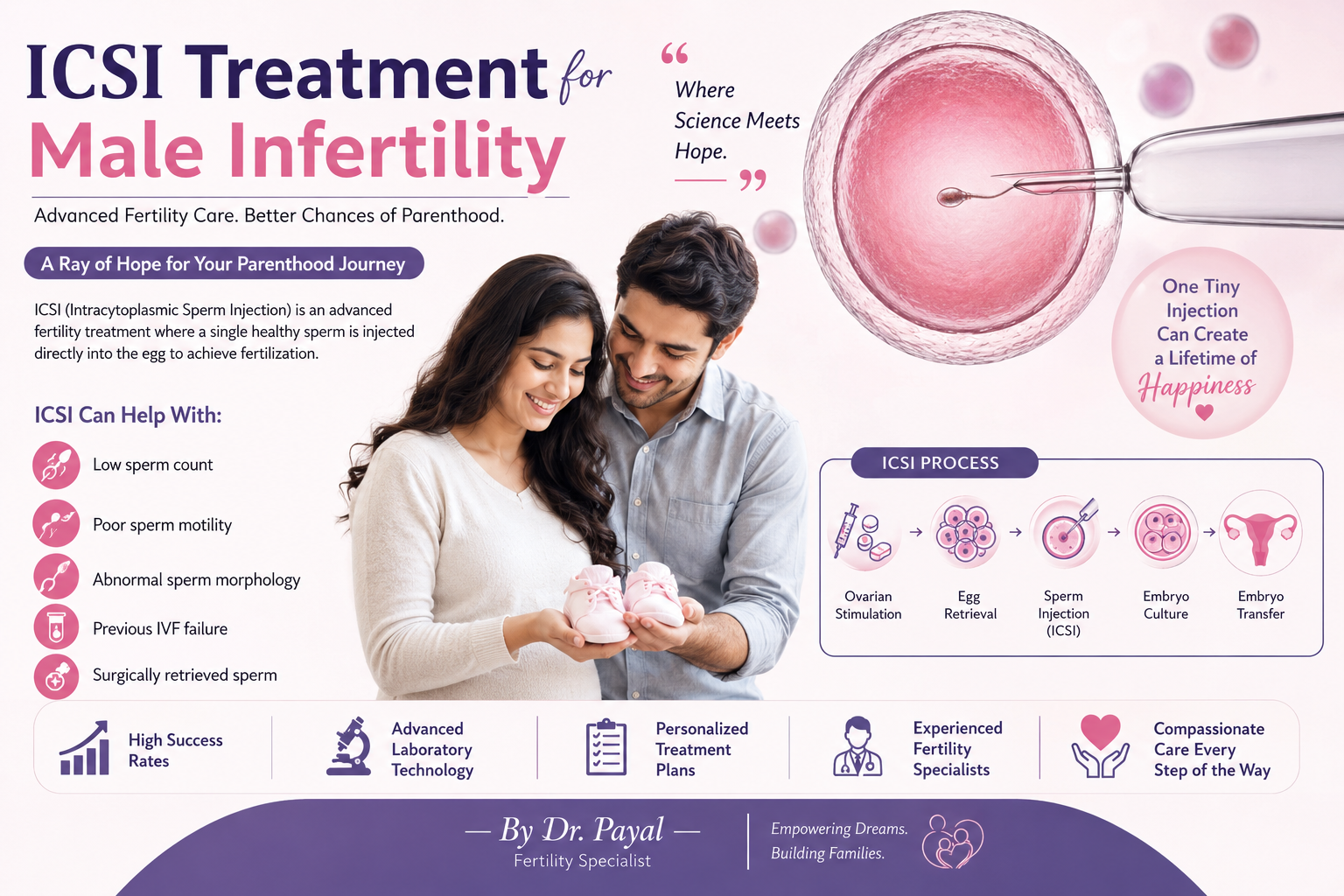
Infertility is a deeply personal journey that affects not only a couple’s ability to conceive but also their emotional well-being. While infertility is often thought of as a female concern, medical research shows that male-factor infertility contributes to nearly 40–50% of infertility cases. Fortunately, advances in reproductive medicine have made parenthood possible for many couples facing these challenges.
One of the most significant breakthroughs in fertility treatment is Intracytoplasmic Sperm Injection (ICSI). This highly specialized procedure has transformed outcomes for couples dealing with severe male infertility and has helped millions achieve successful pregnancies worldwide.
As a fertility specialist, I often meet couples who are anxious about the diagnosis of male infertility and uncertain about the treatment options available. In this article, I will answer some of the most common questions about ICSI, explain how the procedure works, discuss success rates and costs, and help you understand whether it may be the right choice for your fertility journey.
Intracytoplasmic Sperm Injection (ICSI) is an advanced laboratory procedure performed as part of an IVF cycle. In ICSI, a single healthy sperm is carefully selected and injected directly into a mature egg using specialized microscopic equipment.
In natural conception, a sperm must travel through the female reproductive tract and successfully penetrate the egg on its own. However, when sperm quality or quantity is significantly reduced, fertilization may not occur naturally. ICSI bypasses these barriers and gives fertilization a much better chance of success.
For many men diagnosed with severe fertility issues, ICSI has become the most effective treatment option available.
Many patients assume that IVF and ICSI are the same treatment. While both procedures share several steps, the fertilization process is different.
During standard IVF:
This method works well when sperm count and quality are reasonably normal.
During ICSI:
| Feature | Conventional IVF | ICSI |
|---|---|---|
| Fertilization Method | Natural fertilization in laboratory | Direct sperm injection |
| Sperm Requirement | Moderate to high | Very low |
| Male Infertility Cases | Limited effectiveness | Highly effective |
| Fertilization Control | Less controlled | Highly controlled |
| Severe Male Factor Infertility | Not always suitable | Preferred treatment |
ICSI is essentially a specialized form of IVF designed to overcome fertilization problems caused by male infertility.
Before beginning treatment, a comprehensive fertility evaluation is essential. This helps identify the underlying causes of infertility and allows us to create a personalized treatment plan.
This is the primary test used to assess:
Blood tests may include:
For severe male infertility, we may recommend:
This test evaluates sperm DNA quality and may provide valuable information in cases of recurrent IVF or ICSI failure.
Because successful pregnancy depends on both partners, female fertility evaluation is equally important.
This may include:
These investigations help us maximize the chances of treatment success.
One of the most common questions patients ask is whether ICSI is complicated or painful. The procedure itself is highly sophisticated, but from the patient’s perspective, it follows a structured and well-established treatment process.
The female partner receives fertility medications for approximately 10–14 days to stimulate the development of multiple eggs.
Regular monitoring includes:
Once the eggs are mature, they are collected through a minimally invasive procedure performed under sedation.
The procedure usually takes about 20–30 minutes.
Sperm may be obtained through:
Under a high-powered microscope, the embryologist identifies the healthiest sperm based on movement and appearance.
Using an extremely fine glass needle:
This delicate procedure requires significant expertise and precision.
The following day, embryologists examine the eggs to determine whether fertilization has occurred successfully.
The resulting embryos are cultured in specialized incubators for several days.
The healthiest embryo is selected and transferred into the uterus using a thin catheter.
This procedure is typically painless and does not require anesthesia.
An ICSI cycle generally takes 4–6 weeks from the initial consultation to the pregnancy test.
While timelines can vary slightly between patients, most couples complete a treatment cycle within one to one-and-a-half months.
One of the most practical concerns couples have is understanding the financial commitment involved.
The cost of ICSI in Bangalore varies depending on:
| Treatment Component | Estimated Cost |
|---|---|
| Initial Evaluation | ₹5,000–₹20,000 |
| Fertility Medications | ₹40,000–₹1,00,000 |
| ICSI Procedure | ₹1,20,000–₹2,50,000 |
| Embryo Freezing | ₹20,000–₹50,000 |
| Genetic Testing | ₹50,000–₹1,50,000 |
Most ICSI cycles in Bangalore typically range between:
₹1.5 lakh and ₹4 lakh per cycle
The final cost depends on each patient’s medical needs and treatment plan.
ICSI has significantly improved fertility outcomes for couples with male-factor infertility.
On average:
Success depends largely on:
Approximate pregnancy rates per embryo transfer are:
50–60% or higher
40–50%
30–40%
Lower but still possible
It is important to understand that while ICSI improves fertilization rates, overall pregnancy success is strongly influenced by egg quality and maternal age.
ICSI is considered a safe and widely practiced fertility treatment. However, every medical procedure carries some degree of risk.
Rarely, patients may develop:
Ovarian Hyperstimulation Syndrome (OHSS)
Symptoms may include:
Modern stimulation protocols have greatly reduced this risk.
Although uncommon, possible complications include:
Despite direct sperm injection, not all eggs fertilize successfully.
Transferring more than one embryo increases the likelihood of twins or higher-order pregnancies.
Some forms of severe male infertility may have a genetic basis. In such cases, genetic counseling may be recommended before treatment.
Absolutely.
One of the most common reasons we recommend ICSI is a previous failed IVF cycle.
In conventional IVF:
ICSI bypasses the sperm’s need to penetrate the egg naturally.
This approach can be particularly effective for couples who have experienced:
Many patients achieve successful pregnancies after switching from conventional IVF to ICSI.
Although uncommon, fertilization failure can still occur after ICSI.
As fertility specialists, we carefully review every aspect of the treatment cycle.
Further options may include:
A failed cycle does not necessarily mean future cycles will fail. Many couples achieve success after adjusting the treatment approach.
Male infertility can be emotionally challenging, but today’s reproductive technologies offer solutions that were unimaginable just a few decades ago. ICSI has transformed the treatment of severe male-factor infertility by making fertilization possible even when sperm numbers or quality are significantly compromised.
As a fertility specialist, I believe that every couple deserves individualized care, accurate diagnosis, and a treatment plan tailored to their unique circumstances. With proper evaluation, expert laboratory support, and evidence-based treatment, ICSI offers an excellent opportunity for many couples to achieve their dream of parenthood.
If you have been diagnosed with male infertility, experienced failed IVF, or are considering fertility treatment options, consult a qualified fertility specialist to understand whether ICSI may be the right path forward for you.