
ICSI Treatment: How It Works and How It Differs from IVF
When a semen analysis shows a low sperm count or poor movement, many couples hear the term ICSI for the first time. ICSI treatment has changed the outlook for many couples facing male infertility, because it needs only a single healthy sperm for each egg. It is a laboratory technique within IVF, not a separate treatment, and it is not needed by every couple.
This guide explains what ICSI is, how it differs from standard IVF, who it may help and what to expect.
What Is ICSI?
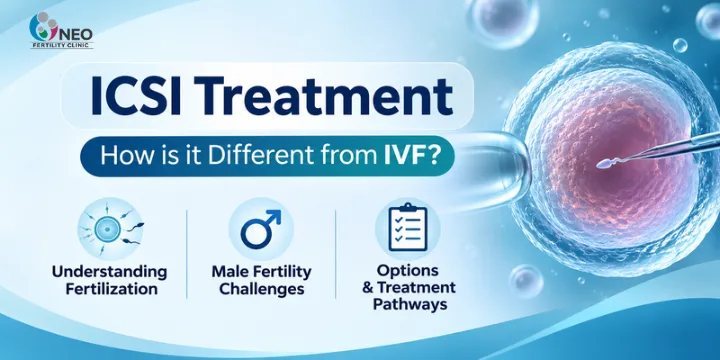
ICSI stands for intracytoplasmic sperm injection. In the laboratory, an embryologist selects a single sperm and injects it directly into the centre of a mature egg, using a very fine needle under a powerful microscope. This is repeated for each mature egg. The eggs are then watched to see whether they fertilise and grow into embryos. Our ICSI treatment page explains how the clinic uses the technique.
How ICSI Differs from Standard IVF
The two follow the same path until the eggs are collected. The woman has stimulation injections, monitoring scans and an egg retrieval in both. The difference is the fertilisation step:
- In standard IVF, eggs are placed in a dish with many prepared sperm, and a sperm enters each egg on its own.
- In ICSI, an embryologist injects one chosen sperm into each egg.
After fertilisation, embryo culture and transfer are the same. For an overview of the full cycle, see our page on IVF treatment.
Who ICSI Treatment May Help
A doctor may suggest ICSI when:
- The sperm count is very low. Too few sperm are available for standard IVF.
- Sperm movement or shape is poor. Sperm may struggle to enter the egg on their own.
- Sperm has been collected surgically. This often applies to men with azoospermia.
- Fertilisation failed in an earlier IVF cycle. ICSI can help when eggs did not fertilise before.
- Frozen eggs or limited frozen sperm are used. ICSI makes the best use of a small number.
- Embryos will be genetically tested. ICSI avoids contamination from extra sperm.
If the semen analysis is normal and there is no history of failed fertilisation, standard IVF may be enough.
ICSI as Part of Male Infertility Treatment
Male infertility treatment starts with finding the cause. A male infertility specialist will usually review a semen analysis, examine the testes and check hormones. Some causes, such as infections, hormone problems or a varicocele, can be treated directly. ICSI becomes one of the main male fertility treatment options when the cause cannot be corrected or when sperm numbers stay very low. Our page on male infertility treatment covers the full range of options.
Azoospermia Treatment and ICSI
Azoospermia means no sperm are found in the semen. It has two broad types:
- Obstructive azoospermia. Sperm are made, but a blockage stops them reaching the semen.
- Non-obstructive azoospermia. The testes make very few or no sperm.
Azoospermia treatment often involves taking sperm directly from the epididymis or testis through a minor procedure. Any sperm found can be used for ICSI, either fresh or frozen. Sperm cannot always be found, especially in non-obstructive cases, so doctors explain this carefully beforehand. Genetic tests may be advised in some men.
The ICSI Treatment Process, Step by Step
- Assessment of both partners. Tests guide whether ICSI is needed.
- Ovarian stimulation and monitoring. As in IVF.
- Egg retrieval. A short procedure under sedation.
- Sperm collection. From a fresh sample, frozen sample or surgical retrieval.
- Injection. One sperm is injected into each mature egg.
- Embryo culture. Fertilised eggs grow in the laboratory for a few days.
- Embryo transfer. One embryo is placed in the uterus. Others may be frozen.
- Pregnancy test. Usually about two weeks later.
Risks and Things to Know
ICSI carries the same risks as an IVF cycle for the woman, including a rare over-response to stimulation medicines. A small number of eggs may be damaged during injection. Studies of children born after ICSI are broadly reassuring, although some suggest a small increase in certain risks, which may partly reflect the underlying cause of infertility. Your doctor can discuss what this means for you, and genetic counselling may be offered in some cases.
Questions to Ask Your Doctor
- Why do you suggest ICSI rather than standard IVF for us?
- What did our semen analysis show, and could it improve?
- If sperm retrieval is needed, which procedure do you suggest?
- Should we have any genetic tests first?
- What happens to embryos we do not use straight away?
Conclusion
Find the Right Treatment Path for Your Family
ICSI treatment can help when sperm count or movement is a concern, but it is one part of an IVF cycle and is advised case by case, after both partners have been assessed. Understanding why it is suggested, and what else could be tried, helps you decide with confidence.
At Neo Fertility Clinic, Bangalore, we focus on assessing both partners and explaining treatment options based on each couple's individual needs. If you're considering ICSI or have questions about male fertility, you can consult our team at our clinic in Munnekolala, near Marathahalli Bridge, Bengaluru. For appointments or enquiries, contact us at +91 73377 61236 or visit neofertility.co.in.
This article is for general information and does not replace an in-person consultation. Suitability and results vary from person to person.